| Matrix t |
|---|
| Notation |
 |
|---|
| Parameters |
 location (real location (real  matrix) matrix)
 scale (positive-definite real scale (positive-definite real  matrix) matrix)
 scale (positive-definite real scale (positive-definite real  matrix) matrix)
 degrees of freedom (real) degrees of freedom (real) |
|---|
| Support |
 |
|---|
| PDF |
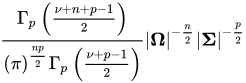

|
|---|
| CDF |
No analytic expression |
|---|
| Mean |
if  , else undefined , else undefined |
|---|
| Mode |
|
|---|
| Variance |
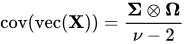 if if  , else undefined , else undefined |
|---|
| CF |
see below |
|---|
In statistics, the matrix t-distribution (or matrix variate t-distribution) is the generalization of the multivariate t-distribution from vectors to matrices.
The matrix t-distribution shares the same relationship with the multivariate t-distribution that the matrix normal distribution shares with the multivariate normal distribution: If the matrix has only one row, or only one column, the distributions become equivalent to the corresponding (vector-)multivariate distribution. The matrix t-distribution is the compound distribution that results from an infinite mixture of a matrix normal distribution with an inverse Wishart distribution placed over either of its covariance matrices, and the multivariate t-distribution can be generated in a similar way.
In a Bayesian analysis of a multivariate linear regression model based on the matrix normal distribution, the matrix t-distribution is the posterior predictive distribution.