Bohr–Sommerfeld model
| Part of a series of articles about |
| Quantum mechanics |
|---|
The Bohr–Sommerfeld model (also known as the Sommerfeld model or Bohr–Sommerfeld theory) was an extension of the Bohr model to allow elliptical orbits of electrons around an atomic nucleus. Bohr–Sommerfeld theory is named after Danish physicist Niels Bohr and German physicist Arnold Sommerfeld. Sommerfeld showed that, if electronic orbits are elliptical instead of circular (as in Bohr's model of the atom), the fine-structure of the hydrogen atom can be described.
The Bohr–Sommerfeld model added to the quantized angular momentum condition of the Bohr model with a radial quantization (condition by William Wilson, the Wilson–Sommerfeld quantization condition):
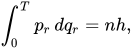
where pr is the radial momentum canonically conjugate to the coordinate q, which is the radial position, and T is one full orbital period. The integral is the action of action-angle coordinates. This condition, suggested by the correspondence principle, is the only one possible, since the quantum numbers are adiabatic invariants.