Bendixson–Dulac theorem
In mathematics, the Bendixson–Dulac theorem on dynamical systems states that if there exists a function (called the Dulac function) such that the expression


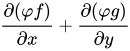
has the same sign () almost everywhere in a simply connected region of the plane, then the plane autonomous system

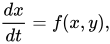
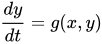
has no nonconstant periodic solutions lying entirely within the region. "Almost everywhere" means everywhere except possibly in a set of measure 0, such as a point or line.
The theorem was first established by Swedish mathematician Ivar Bendixson in 1901 and further refined by French mathematician Henri Dulac in 1923 using Green's theorem.